Transparent proxy
Keep the application-facing database protocol while placing cache behavior in an explicit, observable layer.
 houdata.
CacheDB by houdata.
CacheDB is a transparent database proxy that observes repeated reads, reuses results where policy permits, and makes cache behavior visible to the operators responsible for the system.
The operating model
CacheDB sits between the application and the database. It can preserve the client protocol, use Redis for cache data and control signals, and route every miss back to the source of truth. It is designed for teams that need evidence, boundaries, and an incremental path—not a promise of effortless modernization.
Capabilities
Each capability is intended to be inspected against your database protocol, identity model, traffic pattern, and deployment boundary.
Keep the application-facing database protocol while placing cache behavior in an explicit, observable layer.
Begin in transparent mode, then enable full caching only where the workload and policy support it.
Connect changed tables and query metadata so cached results are refreshed when their source data changes.
Review query patterns, cache outcomes, alerts, policy activity, and audit history from the console.
Use reviewed Rhai hooks for TTLs, bypass rules, SQL adaptation, and invalidation decisions; the console AI assistant can analyze proxy traffic and propose candidates for review and validation.
Deploy in constrained environments with locally verified licensing and no control-plane dependency.
Compatibility
Native wire relays support PostgreSQL and MySQL. PostgreSQL-front-end translation paths are available for PostgreSQL, Oracle, SQL Server, and DB2.
| Backend | Client protocol | Path | Consideration |
|---|---|---|---|
| PostgreSQL | PostgreSQL | Native relay | Recommended PostgreSQL path. |
| MySQL | MySQL | Native relay | Preserves the native client protocol. |
| Oracle | PostgreSQL | Translation | Operator-supplied licensed driver. |
| SQL Server | PostgreSQL | Translation | Evaluate types and SQL semantics. |
| IBM DB2 | PostgreSQL | Translation | Operator-supplied licensed driver. |
Built for operators
CacheDB surfaces query activity, cache outcomes, alerts, audit events, and policy context. Transparent mode lets teams establish a baseline before result reuse is enabled.
Explore console operations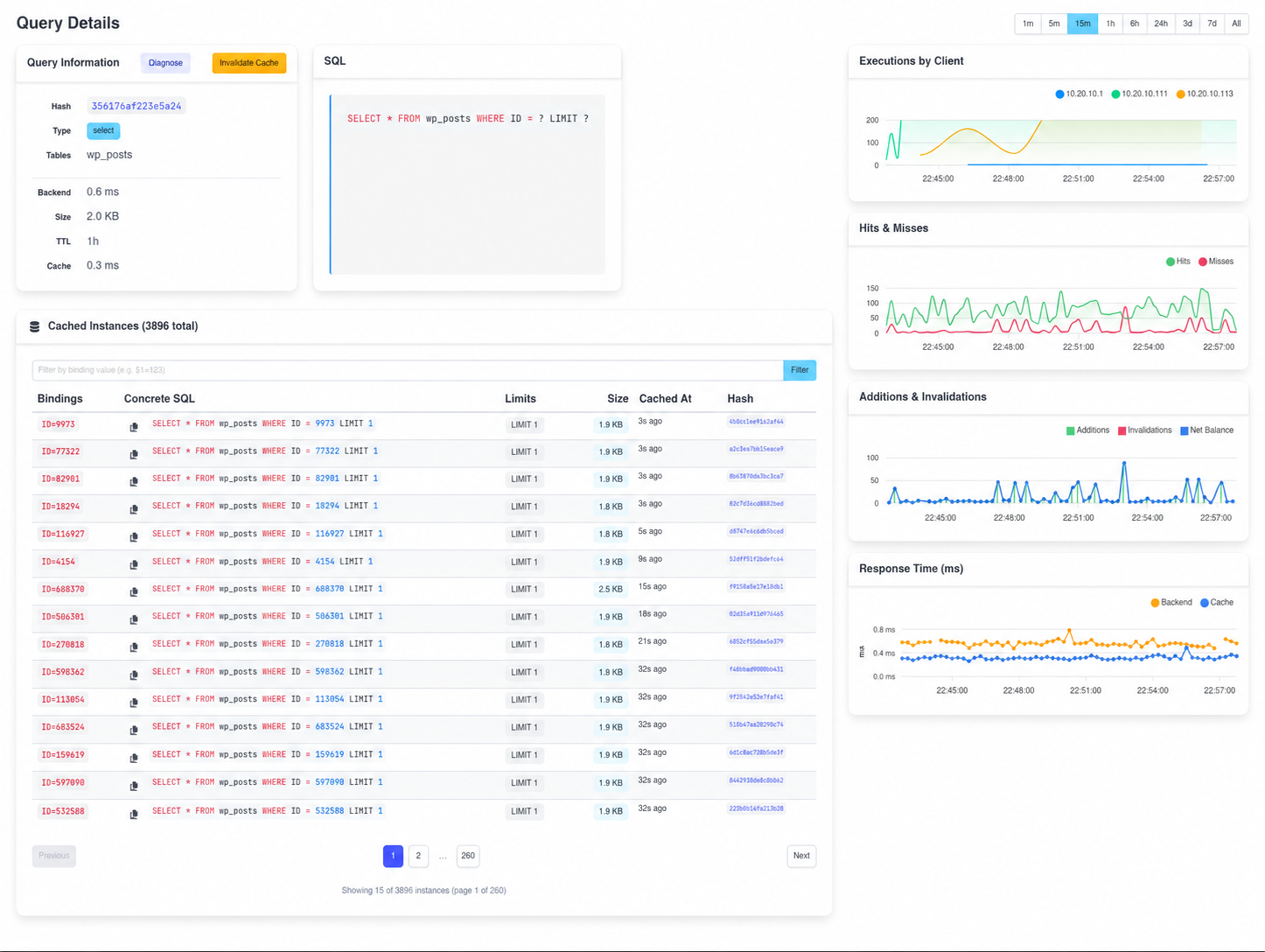
Designed with boundaries
CacheDB 1.9 has explicit transport limits. It does not act as a general TLS endpoint for native proxy traffic or Redis connections. Deploy proxy, database, and Redis on a trusted private segment, or provide encryption and edge controls at the deployment layer.
Cache identity also matters: do not share a cache namespace across database identities with different row-level or object-level permissions.
Read the security boundariesTechnical conversation
Start with the database, client protocol, workload shape, and performance constraint you are actually responsible for.